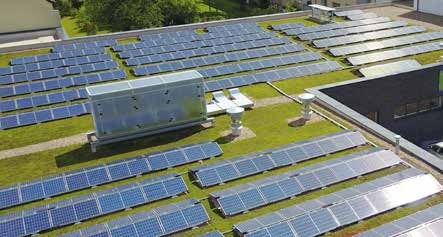
Sika NatureRoof PV project.
The drive to decarbonise the built environment is accelerating, and solar photovoltaics (PV) are increasingly being adopted by building owners seeking to generate renewable electricity and reduce reliance on grid-supplied energy. Across the education estate in particular, UK government-backed initiatives are helping schools and colleges access solar through power purchase agreement (PPA) models that require no upfront capital investment, with pilot programmes already targeting up to 150 educational sites and wider rollout anticipated in the coming years.
Amid the enthusiasm for retrofitted renewable energy solutions, one crucial consideration is often overlooked: the condition of the existing roof itself. For any solar PV installation to deliver long-term value, the roof beneath it must be capable of supporting the system throughout its operating life. A solar array may have an expected service life of 25 years or more, meaning any weaknesses in the waterproofing system, insulation or roof structure can quickly undermine the anticipated return on investment.
THE HIDDEN RISK
While solar PV continues to become more accessible, the roof remains the most important asset in the overall system. Government guidance and sector best practice recognise that solar installations should form part of a wider building improvement strategy rather than being treated as a standalone addition.
The challenge arises when ageing roofs are used as the foundation for new solar investments. If roof deterioration subsequently requires remediation, the solar array may need to be temporarily removed and reinstalled before roofing works can take place. This introduces significant additional costs and disruption.
In many cases, a comprehensive roof condition survey undertaken before any solar specification is developed can identify issues that are relatively straightforward to address. Replacing or refurbishing a roof before panel installation is typically far more cost-effective than undertaking remedial works once the PV system is operational.
TAKING A WHOLE-LIFE APPROACH
A successful solar project requires everyone to consider the roof and the renewable energy system as a single long-term investment. This means assessing several critical factors at an early stage, including:
• The condition and remaining service life of the waterproofing system
• Structural load-bearing capacity
• Compatibility between roofing and solar mounting systems
• Future maintenance access requirements
• Fire performance of the complete roof assembly.
Of these considerations, fire safety has become increasingly important. The addition of PV equipment changes the characteristics of a roof system and should prompt a thorough review of fire classification and compliance requirements. Roofing and solar components must be specified as part of an integrated system that satisfies relevant regulations and standards.
Unintended damage to the waterproofing layer is one of the most common risks associated with solar installations. Traditional mounting methods can involve roof penetrations, which may create long-term vulnerabilities if they are not carefully designed and installed. For this reason, industry guidance increasingly recommends solutions that minimise disruption to the waterproofing system while still providing secure PV mounting performance.
Sika Roofing has developed solar roofing solutions designed specifically to support rooftop renewable energy projects. The company’s SolarRoof and NatureRoof PV Mounting systems, when correctly specified and installed, can be integrated with compatible roofing membranes while helping to maintain the waterproofing system. Non-penetrating attachment approaches can reduce the risk of compromising the roof system and simplify long-term maintenance requirements.
Through the Department for Education’s PPA programmes, schools and colleges can access solar installations without significant upfront expenditure, allowing them to benefit from on-site renewable electricity generation that may contribute to lower energy costs and reduced operational carbon emissions. However, these benefits can only be fully realised if the underlying building fabric is ready to support the investment.
For many schools, flat roofs installed decades ago may be approaching the end of their useful life. Refurbishing them before any solar installation provides an opportunity to upgrade waterproofing systems, improve thermal performance and create a suitable platform for renewable energy generation. gbr.sika.com