Ask 10 people what they understand biodiversity to mean and you will likely get 10 different answers. Biodiversity is the scientific measure of all species, vegetation, habitats and ecosystems around the planet. It describes the complexity of life at every level, from the microscopic building blocks of genetics to entire ecosystems like forests and oceans. A biodiverse ecosystem maintains soil fertility, regulates the climate, cycles vital nutrients, pollinates crops, and provides medicines and raw materials.
One of the biggest threats to biodiversity is the change of land use, both through the extension of agriculture and new building developments. Over the past five decades the rates of extinction have accelerated many times faster than usual. Many species of birds have become extinct or reduced significantly in numbers as have many insects.
However, it is possible to restore lost ecosystems by planting trees, shrubs, wildflower meadows, and reintroducing lost animals. Developers are now legally required to deliver a Biodiversity Net Gain (BNG) on major housing projects. Under the Environment Act 2021, BNG is mandatory for developments that need planning permission, where developers must deliver a BNG of at least 10%. This means a development may result in more or higher quality natural habitat than there was before the start of the development.
From November 2026, BNG will also apply to nationally significant infrastructure projects. Developers must try to avoid or minimise harm to existing nature on site and enhance existing spaces or create new green features. Natural England provides a standard calculation tool to score pre- and post-development value of habitats.
Some 28 major UK housebuilders have signed up to a voluntary pledge, led by Homes for Nature, to establish best practices for enhancing wildlife, supporting climate resilience and improving people’s health and wellbeing on new developments. These include installing bat roosts, bird nesting boxes and insect nesting areas. There are also other initiatives such bee bricks, as well as nature-focused drainage and pollinator-friendly wild plants.
Manthorpe Building Products is supporting initiatives to promote biodiversity by developing products in cooperation with several well-known and respected wildlife organisations. These include swift nesting boxes within a brick sized module and a bat roost within a dry ridge end cap.
SWIFT BRICK
Around half of the UK swift population has disappeared in the last 20 years as the birds find it increasingly difficult to find suitable nesting sites, particularly as modern building legislation means new homes are built without nooks and crannies for birds and bees to nest in.
The Manthorpe Swift Nesting Brick has been developed in partnership with several major housebuilders and conservation experts, including RSPB and Action for Swifts. It is the same size as a standard brick, with a small, sheltered hole for the bird to get through. The internal section takes advantage of the wall cavity to provide a habitable space for the swift to nest, lay its eggs, and for the chicks to grow. There is a concave section in which the swift can build its nest and there are integrated floor grips to give the birds better traction. A Dual Swift Brick has a compact design suitable for narrower cavity walls down to 50mm wide. Its ambidextrous design has left or right-hand entrance options. A rendered wall option is also available.
BAT RIDGE ROOST
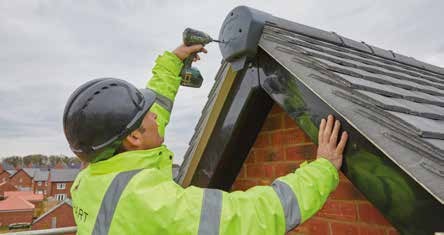
Bats make an important contribution to plant pollination. But they are also finding it increasingly difficult to locate suitable roosting spots in buildings. Developed in partnership with the Bat Conservation Trust Roost Partnership, the Manthorpe Bat Ridge Roost seamlessly integrates with the Manthorpe SmartVerge systems, both the handed and ambidextrous versions, though it is just as effective when used with other, third-party dry verge systems and even with traditionally mortar bedded roof verges. The Bat Ridge Roost is designed as a ridge end cap to suit round or angle ridge tiles.
Like a standard ridge end cap, it provides a durable and protected covered finish where the roof verges meet the end of the ridge line. It houses a secure self-contained interior space, which encourages small crevice-dwelling bat species to use it as their habitable roost and without access into the roof space of the building. Being at the end of a ridge, generally the highest point of a building, makes the Bat Ridge Roost highly desirable for the bats who seek a high vantage point, with protection from the elements and predators. Internal climbing grooves and a roughened surface allow easier manoeuvrability inside the roost box and insulated walls create a temperature stable environment.
Manthorpe Building Products is actively supporting the UK construction industry’s transition to more sustainable and bio-diversity friendly practices. These products directly support specifiers and housebuilders in meeting regulatory requirements as well as supporting biodiversity aims. www.manthorpebp.co.uk