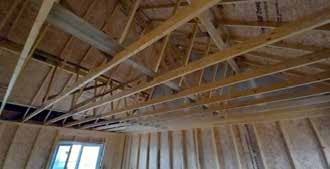
Photograph courtesy of Kirkwood Timber Frame.
Drive north across the border and something different reveals itself in how homes are built. Beneath the surface Scotland has, over time, reshaped the fundamentals of housing delivery – how homes are constructed, who builds them, and how confidently the system moves toward its targets.
Scotland has been explicit that it needs around 25,000 homes a year. That figure gives the entire industry a shared point of orientation that progress can be measured against. In England, by contrast, housing targets have often felt more fluid, subject to political shifts and local resistance.
The real story lies in how Scotland has transformed its construction practices, most notably through its near-universal embrace of timber frame. What might still be considered an ‘alternative method’ in parts of England has become entirely mainstream north of the border. Today, some 92% of new homes in Scotland are built using timber frame systems. Building with pre-manufactured structural panels assembled offsite changes the entire rhythm of delivery. Time on site is shorter. Exposure to weather is reduced. Waste is minimised. Quality becomes more consistent because it is controlled in factory settings rather than improvised in the field.
These efficiencies compound. Developments move faster. Risks are easier to manage. And critically, performance improves. Homes built this way are capable of significantly lower energy consumption, with some cutting energy costs by as much as 60%. Nearly all new homes in Scotland now achieve EPC band B or better, contributing to a housing stock that is not only growing, but improving in quality.
Scotland also benefits from the continued strength of small and medium-sized developers. SMEs building fewer than 1,500 homes a year are responsible for around 40% of total housing output. Smaller developers are often more agile, better positioned to unlock smaller or more complex sites, and more deeply connected to local economies. Their presence diversifies delivery and reduces reliance on large housebuilders.
Many SMEs are actively adopting timber frame systems, showing that modern methods of construction are scalable, adaptable, and increasingly accessible.
England needs to recognise what has made Scotland’s progress possible. A clear articulation of need. Normalising more efficient construction methods. Maintaining a diverse developer base. And understanding that better homes which are faster, greener, and cheaper to run, can be achieved today. uk.westfraser.com