HEATING, PLUMBING AND VENTILATION
From record-breaking rainfall and heatwaves to increased pressures on an already-aging infrastructure, cities are at the forefront of the climate change challenge. As extreme weather events become increasingly frequent and severe, our urban areas need to adapt – for environmental factors and to accommodate a changing population.
As people move away from vulnerable areas to places they deem to be safer, greener and generally more liveable, regions with robust infrastructure and high-quality urban environments will become more attractive places to live and work, placing a higher demand on resources and making resilience a defining feature of urban environments.
But in 2026, resilience is about evolution and adaption, managing both too much and too little water, reducing vulnerability to flooding, overheating and drought, ensuring critical infrastructure continue to function during extreme events, and creating healthier, greener places for communities. At the centre of ensuring this resilience is water – an element that’s often treated as something to remove as quickly as possible, not as a resource.
To ensure resilience for our cities, we need to retain, store, reuse and manage water intelligently – and that can no longer be done with a single solution. We’re all aware of the concept of the four pillars of SuDS, but to achieve true resilience, we need consider four new pillars.
With this approach, we can still deliver the reliable, high-capacity and quick control that is expected of grey infrastructure, but the rise of nature-based solutions brings a wealth of new opportunity to create various benefits from a single investment.
The next pillar is biodiversity – a topic that has rightly gained increased prominence since the introduction of the Biodiversity Net Gain (BNG) mandate in 2022. As well as performing efficient drainage functions, these systems all bring valuable opportunities for measurable ecological enhancement and habitat creation, contributing to pollinator-friendly planting, species richness, better soil health, moisture retention and urban canopy growth – the latter of which is particularly useful in tackling the urban heat island effect, where cities are warmer than nearby rural areas.
The urban heat effect comes as a result of the use of darker building materials (which absorb the sun’s energy, instead of reflecting it), significantly less plant life and trapped heat in materials that have high thermal mass, like brick. Our cities are becoming hotter – the record-breaking heatwaves of this summer confirm that – and water management and urban cooling are challenges that are becoming increasingly intertwined but so are the solutions. Nature-based solutions bring increased tree and vegetation coverage which, in turn, brings increased urban cooling.
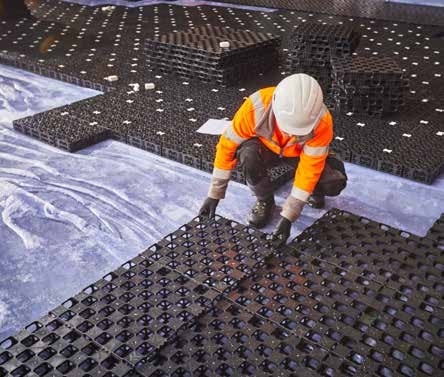
Nature-based solutions are good, but community-based solutions are even better. By integrating SuDS in places that people already value (playgrounds with permeable flooring, for example), drainage infrastructure becomes multifunctional community assets that bring a wealth of social value benefits, including producing attractive and healthy public spaces, and greener neighbourhoods that boost community wellbeing and economic resilience.
Climate adaption is both a requirement for the future, and an important present day design consideration. The resilient cities of the future will be defined by efficient use of water and, by integrating grey with green, we can create cities that are better equipped to withstand climate challenges and support thriving wildlife and communities for years to come.
www.polypipecivils.com
Future success lies in the use of integrated water management systems that combine capacity and adaptability with environmental value, meaning we move beyond a choice of traditional ‘grey’ (pipes, tunnels, tanks) versus green (nature-based) infrastructure, instead embracing a complementary dual approach that harnesses the strengths of each.
At Polypipe Civils & Green Urbanisation, our twin approach – using grey solutions to intercept and store foul water overflow from treatment works to remove risk of spills into rivers and green sustainable urban drainage systems (SuDS) to intercept and manage stormwater at the surface, disconnecting from the wider CSO system, reducing the capacity required and preventing spills – underpins our efforts to make space for more water.