Noise is one of the most pervasive yet frequently underestimated challenges in building design. Whether it is the rumble of traffic filtering through a hospital ward, the thud of footsteps echoing through a school corridor or the clatter of a busy office bleeding into a meeting room, unwanted sounds affect the health, wellbeing and productivity of the people inside our buildings every single day. The good news is that, by making acoustic performance a design priority from the outset, it can be effectively managed with the right approach and products.
There is now a substantial body of evidence on the negative effects of noise exposure. Elevated noise levels have been linked to increased stress, disturbed sleep, high blood pressure, cardiovascular conditions and even a heightened risk of developing diabetes. In workplaces noise impairs productivity, increases the likelihood of errors and reduces employee satisfaction. In schools, the consequences can be particularly far-reaching: studies have consistently demonstrated that higher noise levels slow cognitive development, reduce test performance and compromise the speech intelligibility that underpins effective teaching and learning.
THE REGULATORY FRAMEWORK
Understanding which regulations apply to a given building type is an essential starting point. In England and Wales, Approved Document Part E of the Building Regulations sets acoustic performance standards for residential buildings and those providing residential-type accommodation. Section 5 of the Building Standards serves an equivalent function in Scotland.
Beyond the residential sector, specific standards exist for healthcare facilities, most notably Health Technical Memorandum (HTM) 08-01: Acoustics, which sets out detailed requirements for hospitals and other NHS settings.
Educational buildings are subject to a particularly layered set of requirements. In England and Wales, Requirement E4 within Part E of the Building Regulations applies specifically to schools, stipulating that each room or space must be designed and constructed so that it has acoustic conditions and insulation against noise disturbance appropriate to its intended use.
New and existing schools must also comply with either the School Premises Regulations 2012 for local authority-maintained schools or the Independent School Standards 2013, both of which cover acoustic conditions across all areas of a school building, not just teaching spaces. Importantly, these regulations also apply to temporary buildings, which are otherwise exempt from Part E.
To satisfy these requirements, schools are expected to meet the performance standards set out in Building Bulletin 93 (BB93), the acoustic design guide published by the Department for Education. BB93 specifies limits for ambient noise levels, airborne sound insulation, impact sound and reverberation times across different types of teaching and activity spaces.
The thresholds are generally set at a level that ensures a comfortable environment, though more sensitive areas, such as spaces designed for pupils with special hearing or communication needs, are subject to lower permitted levels. It is also worth noting that while BB93 does not have a statutory footing in further and higher education, many colleges and universities choose to adopt it as a design benchmark, recognising its value as a practical guide to acoustic best practice.
MANAGING EXTERNAL NOISE
External noise represents the most persistent acoustic challenge for the majority of public buildings, particularly
those situated in urban environments or close to major transport infrastructure. Road traffic, aircraft, rail, construction activity and even playground noise can all penetrate the building envelope to a significant degree if not adequately addressed. Depending on the roof construction, the impact noise of rain and hail can also be a meaningful source of internal disturbance – in some cases, studies suggest that noise levels from rainfall inside a school building can reach as high as 70dBA.
The primary response to external noise is to improve the acoustic performance of the building fabric itself. This is generally achieved through the introduction of high-density materials within walls, ceilings and floors, which act as a barrier to sound transmission. Specialist acoustic membranes, such as SOPREMA’s TECSOUND range of viscoelastic, high-density polymer-based membranes, provide effective soundproofing across different construction elements, including walls and roofs, without the need to increase the overall thickness of the build-up.
CONTROLLING INTERNAL SOUND TRANSMISSION
Internal noise is the sound transmitted between different areas of the same building, and takes two principal forms: airborne sound and impact sound. Airborne sound travels through the air and passes through walls, floors and ceilings, while impact sound is generated by direct physical contact with a surface, most commonly from footsteps or the movement of furniture. Both must be addressed in any comprehensive acoustic strategy.
For airborne sound, the mass of the partition is the primary determinant of performance, in a principle known as the mass law, whereby doubling the mass of a single-leaf element increases sound insulation by five to six decibels. Double-leaf constructions, such as cavity walls or twin-layer plasterboard partitions, generally outperform single-leaf equivalents of the same total mass, thanks to the acoustic decoupling effect of the air gap between the layers.
Where lightweight partition systems are specified, additional performance can be achieved through the application of acoustic membranes. TECSOUND SY, for example, is a self-adhesive membrane developed specifically for application directly onto gypsum plasterboards, improving airborne sound insulation without adding significant thickness or complexity to the installation.
Impact sound, particularly through floors, is best tackled as close to the source as possible. Soft floor coverings, floating floor constructions and purpose-designed acoustic underlay membranes can all be effective in reducing the transmission of footfall and other impact noise to the rooms below. It is also important not to overlook flanking transmission – the indirect passage of sound through shared structural elements such as external walls and floor slabs – which can significantly undermine the performance of otherwise well-designed partitions. Acoustic disconnection strips fitted beneath partition walls are one means of addressing this.
REVERBERATION CONTROL
The third dimension of acoustic design is reverberation control, and this is the one that is all too often neglected in favour of the more visible challenges of sound insulation. Reverberation is the persistence of sound within an enclosed space as it reflects off hard surfaces. In spaces with long reverberation times, words and syllables overlap, making speech significantly harder to follow. Background noise levels rise as a result, which in turn increases stress and mental fatigue among occupants. The larger the space and the harder its surfaces, the more pronounced the problem.
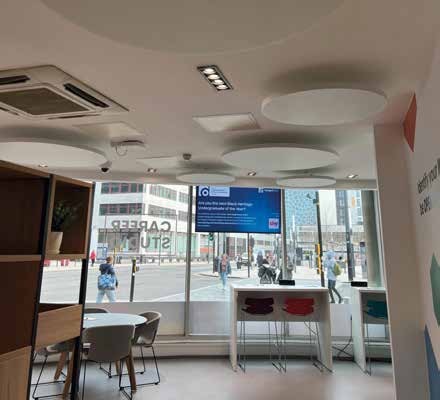
The solution is to introduce sound-absorbing materials that dissipate acoustic energy rather than reflecting it. Soft furnishings contribute to this to some extent, but in most public buildings they need to be supplemented by purpose-made acoustic products installed on walls and ceilings. SOPREMA’s PUREKUSTIK, FIBROKUSTIK and SOPRAKUSTIK ranges are designed precisely for this application, offering high acoustic absorption performance while incorporating decorative options that allow them to be integrated sympathetically into the interior design of a space.
Ultimately, good acoustic design is not a single-product solution; it requires a holistic approach that addresses external noise, internal sound transmission and reverberation in equal measure. Engaging with acoustic product specialists early in the design process is the most effective way to ensure compliance with the relevant regulations, balance acoustic requirements with aesthetic and budgetary constraints, and deliver buildings where people can genuinely concentrate, communicate and thrive. The tools are available; the challenge is simply to use them in the right combination.
SOPREMA has a handy online acoustic reverberation calculator that can help with acoustic design. www.soprema.co.uk