NHS England spends £1.4 billion on energy, making it the single biggest user of energy in the public sector. With this demand only set to rise, the value of solar photovoltaic (PV) systems has become a strategic consideration for NHS estates as decarbonisation pressures fundamentally change how energy is produced and consumed on site.
Estates directors and energy managers know that delivering net-zero emissions while maintaining resilience and affordability will require innovation and on-site generation. Making on-site generation a part of long-term planning is where solar PV, particularly solar carports, takes centre stage, with healthcare estates uniquely positioned to take advantage of their vast carparks.
THE EMERGENCE OF ELECTRIFICATION
It isn’t a surprise that healthcare estates are extremely energy intensive. Beyond lighting and HVAC demand, many host operations 24/7 and rely on power for specialised medical equipment. Demand is constant, and systems that can produce clean energy, affordably on-site are increasingly attractive.
Currently, an era of electrification is being ushered into the healthcare sector. Electrification enables displacement of fossil fuels when paired with low-carbon electricity generation, allowing heat and transport to be decarbonised. When implemented correctly, electrification can reduce greenhouse gas emissions, improve system efficiencies, and support long-term cost control.
However, as with every conversation that centres around sustainability and decarbonisation, it must be grounded in operational reality. The electrification of heat is significantly increasing electricity demand across NHS estates. This demand is increasing faster than on-site generation capacity.
It’s a pattern that is becoming increasingly common across Britain’s NHS estates. As more trusts move away from a reliance on gas, the reality is that energy costs may rise before the benefits of decarbonisation are fully realised. But decarbonisation is not something healthcare estates can delay or ignore.
"Solar is increasingly being deployed across the healthcare sector, allowing estate managers to transition towards electrification with greater confidence.
As national policy, funding mechanisms and public accountability continue to evolve, estate teams are under growing pressure to act. This means that if electrification is to be pursued at scale, it cannot be delivered in isolation. Measures are required that both offset increased electrical demand and mitigate long-term exposure to energy price volatility. This is where solar PV presents a clear and compelling opportunity.
SOLAR AS A SOLUTION
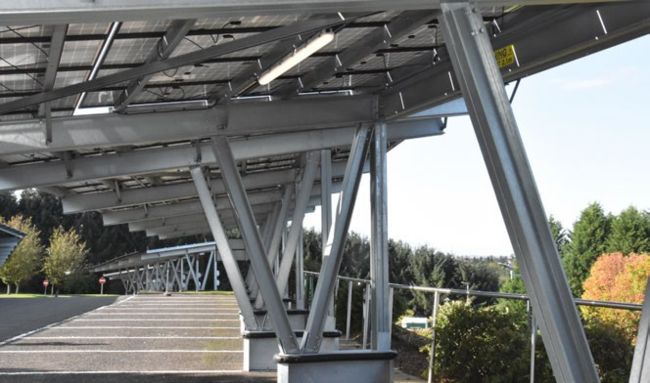
Solar is increasingly being deployed as the solution across the healthcare sector. Implementing and expanding a solar PV portfolio allows healthcare estate managers to transition toward electrification with greater confidence, while meeting rising electric demand and reducing reliance on imported grid electricity. We are already seeing many healthcare estates maximise their rooftop potential, leading to additional deployment options, such as carports integrated with electric vehicle charging infrastructure, being explored.
Multi-storey carparks, of which there are plenty on healthcare estates, are ripe with potential to not only supercharge on-site generation but provide a reliable and in-demand EV charging infrastructure. According to data as recent as January 2026, the UK will have to more than double its current installations of EV charging points to meet estimated 2030 demand.
But this is not as simple as including solar as an ‘add-on’ project. The relationship between solar power and the wider estate infrastructure has evolved, and a more integrated, front-loaded approach to project development has become critical.
Large NHS solar schemes now sit within a complex landscape of heat electrification, grid capacity constraints, private wire arrangements, export limitations and site-wide energy controls.
There are projects where funding has been secured, yet systems remain at risk from not being fully energised or optimised. This can be due to Distribution Network Operator (DNO) constraints, protection settings, or control strategies that have not been adequately considered at an early stage. The result is delays, re-designs and additional costs, often when time, capital and resources are already constrained.
By engaging early with experienced solar and energy infrastructure specialists, healthcare estates can ensure that grid capacity, export management, future electrification plans and operational constraints are designed into the scheme from the outset. This engagement should ideally take place before funding applications are submitted, to ensure value for money is protected. The objective is to avoid stranded assets and ensure that solar actively supports the wider decarbonisation strategy of the estate, rather than creating unintended challenges in the longer term.
PACE SETTING IN HEALTHCARE
While decarbonisation remains a hot button issue for the sector, electrification alone is not a complete solution. Solar PV provides a critical balancing mechanism, helping healthcare estates maintain operational resilience while progressing towards net zero targets, without disproportionately increasing operating costs.
Health estates can realise significant financial and operational benefits by expanding their PV portfolios. Rooftop systems remain the foundation for many sites, but the next phase of deployment increasingly includes solar carports, particularly where electric vehicle infrastructure is also required. To deliver these projects effectively, collaboration and early partnerships with technical specialists is essential ensuring that solar generation, electrification, and grid constraints are considered as part of a single, coordinated energy strategy.
The healthcare estates that invest in well-planned solar infrastructure today will help set the pace for the sector. Leadership will not be defined by speed alone, but by the quality of planning, integration, and delivery. Those organisations that act early, with expertise rather than urgency are likely to become reference points for how decarbonisation can be achieved in a way that is resilient, affordable, and operationally sound. www.renenergy.co.uk

AVOID COSTLY POWER DOWNTIME DURING COLD WEATHER
Site managers are being urged to ensure power systems are serviced and back-up plans put in place to prevent downtime in poor weather.
The Power Systems team at Finning UK & Ireland is advising facilities managers to shore up their contingency operations to protect against costly downtime caused by any future outages.
Engine cold starts, increased friction, fuel gelling, and low battery outputs can all cause significant generator damage if left unaddressed.
With significant financial and functional impact at stake for healthcare estates, establishing good generator health is crucial to protecting continued operations.
Rob Froome, Head of Project Delivery Contracts & Commissioning at Finning, said: “The key is to determine your power requirements, whether you plan to provide power for the entire facility or for critical load only, and then implement a temporary power solution that is tried and tested before you need it.”