The UK roofing market is in transition. With the Future Homes Standard (FHS) now shaping design decisions for newbuild homes and non-domestic buildings, the building envelope – including roof assemblies – is under renewed scrutiny. Lower U-values and enhanced airtightness targets are pushing designers to think ‘fabric first’, while rising concerns over condensation and indoor air quality demand smarter moisture management.
In this environment, specifying the right roofing underlay is critical to durable performance. That’s why Roofshield has re-emerged as a solution aligned with the new performance expectations influencing architects and contractors across the UK.
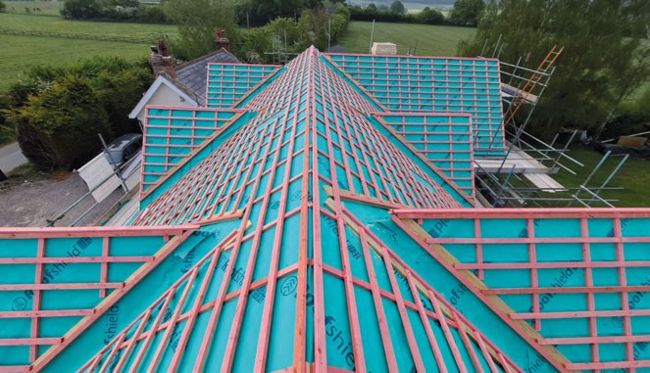
Source:
Baker Roofing Swindon Ltd
WHY MEMBRANE CHOICE MATTERS
The evolving regulatory landscape – most notably the FHS – places greater emphasis on thermal performance, airtightness and whole-life building health. Roofs are expected to limit heat loss, resist moisture ingress and contribute to healthy internal environments without reliance on retrofit fixes.
Breathable membranes like Roofshield address these demands head-on:
• Vapour permeability and air permeability manage moisture movement through the roof structure, reducing the risk of interstitial condensation — a persistent performance challenge in tightly sealed roofs.
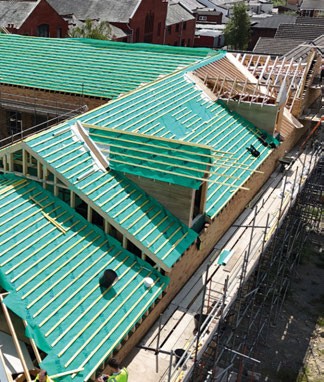
Source:
Baker Roofing Swindon Ltd / Taiyaba Masjid Mosque, Bolton
• Secondary defence against driving rain, wind and snow, ensuring water resistance without compromising breathability.
• Eliminating the additional ventilation hardware requirement in many pitched roof builds, simplifying detailing for specifiers while maintaining robust environmental control.
For architects seeking clarity at the specification stage, Roofshield’s profile, with a patented melt-blown core and three-layer spunbonded polypropylene construction, delivers proven performance rooted in nearly three decades of industry use.
SPECIFYING FOR PERFORMANCE
Roofshield offers a number of key practical benefits for specifiers looking for the right solution.
• Fabric efficiency with moisture control: As thermal envelopes tighten, moisture management becomes non-negotiable. A highly vapour-permeable underlay like Roofshield lets trapped water vapour escape, protecting insulation and structural timbers from degradation over time.
• Reduced risk, lower lifetime cost: By reducing condensation risk and removing the need for mechanical ventilation accessories in cold roofs, Roofshield helps avoid costly remedial work and improves long-term durability.
• Installation confidence: With robust resistance to UV and water penetration, on-site handling and exposure issues are minimised, making Roofshield a contractor-friendly choice where build programmes are being squeezed.
DETAILING THAT WORKS
From eaves to ridge, Roofshield integrates into traditional and contemporary roof build-ups without compromising design intent. Its compatibility with pitched roofs under tiles and slates makes it a versatile option across domestic and non-domestic sectors, which is an important consideration in mixed-use and retrofit projects where performance expectations are rising.
Architects will appreciate how Roofshield contributes not only to compliance with tightening regulations but also to the robust, future-proof assemblies that their clients expect. As the industry moves towards net zero and tighter performance tolerances, membranes that manage air, moisture and durability will be specified more consciously, not as an afterthought, but as an integral piece of the thermal puzzle. www.donlow.co.uk